April 11, 2026 • Celeste Morrow • 9 min reading time • Prices verified June 4, 2026
1 Hour or 8 Hours? The Develop-Time Science Behind St. Tropez, Loving Tan, and b.tan Express Formulas
If you’ve ever stood in a drugstore aisle — or more likely, scrolled a product page at midnight — staring at two bottles of self-tanner that look nearly identical but one says “1 hour” and the other says “8 hours,” you’ve already encountered develop time. Develop time is simply the window between when you apply a self-tanner and when you rinse it off. During that window, a colorless sugar called DHA (dihydroxyacetone) reacts with the outermost layer of your skin cells to produce a brown pigment. The longer DHA sits on your skin before you wash, the deeper and darker the color it builds — up to a ceiling. Express formulas compress that window by front-loading the DHA, changing its concentration so you can reach a wearable result faster. Understanding which system fits your routine, your skin tone, and your finish goals is one of the highest-leverage decisions you make at checkout. This guide breaks down exactly how it works, and what the tradeoff looks like across three benchmark brands.
The DHA Reaction: Why Time Is the Actual Ingredient
DHA is the active molecule behind virtually every mainstream self-tan result, and Healthline’s overview of DHA notes that it has been FDA-approved for external cosmetic use since 1977. When it contacts amino acids in your skin’s stratum corneum (the outermost, dead-cell layer), it triggers a non-enzymatic browning reaction called the Maillard reaction — the same chemistry responsible for browning in baked bread, but happening at room temperature on your skin over hours, not minutes.
What most people miss: the Maillard reaction doesn’t stop the moment you rinse. According to Paula’s Choice’s self-tanning ingredient breakdown, DHA continues developing color for up to 24 hours after application — rinsing simply removes the unbound, surface-level excess, but the reaction already underway in the skin cells keeps progressing. This is why a rinse-off express tan often looks lighter immediately after showering and noticeably deeper by the next morning.
This has a direct implication for how you read develop-time windows on packaging:
- “1 hour” on an express formula means you can achieve a light-to-medium result at the one-hour mark. It does not mean the color stops there.
- “8 hours” on a classic formula means the reaction has had a long, gradual runway — lower DHA concentration doing slow work rather than a short sprint.
- Neither window tells you the final color at hour 24. That number lives in the DHA concentration and your skin’s own amino acid density, not the clock alone.
How Express Formulas Actually Work (and What “Express” Costs You)
The engineering behind a 1-to-3 hour express formula is essentially a concentration trade-off. To accelerate visible color in a compressed window, formulators increase DHA percentage — sometimes meaningfully. Byrdie’s self-tanner explainer notes that standard classic formulas typically run in the 2–5% DHA range, while express formulas can push toward the higher end of that range or beyond, depending on the target depth of result.
Higher DHA concentration creates two downstream effects that intermediate tanners should budget for:
1. Greater margin for error at extended wear. Because the reaction runs faster, leaving an express formula on 30–60 minutes past your target window produces a proportionally larger color jump than the same extra time would on a classic formula. This is where the “I left it on too long” orange stories originate — not from express formulas being inherently orange, but from the steeper dose-response curve.
2. More erythrulose dependence matters here. Some premium express formulas pair DHA with erythrulose, a slower-acting sugar that prolongs color development and helps even out the finish. Paula’s Choice notes that erythrulose develops over 2–3 days and produces a slightly redder-brown tone compared to DHA’s yellower-brown, and that the combination generally produces a more natural result than DHA alone. When you’re evaluating an express formula for finish quality, checking whether erythrulose appears on the ingredient list is a worthwhile filter.
By the Numbers: Develop-Time Comparison Across Three Benchmark Brands
| Formula | Type | Develop Window | Recommended Rinse Range | Post-Rinse Development |
|---|---|---|---|---|
| St. Tropez Express Bronzing Mousse | Express | 1–3 hrs | 1 hr (light) → 3 hrs (dark) | Color deepens ~12–24 hrs post-rinse |
| Loving Tan 2 Hr Express Mousse | Express | 2 hrs | 2 hrs for medium-dark result | Reviewers report continued depth gain overnight |
| b.tan go darker… self tan mousse | Express/Classic hybrid | 1–3 hrs+ | Flexible; longer wear = deeper result | Notable depth at 8 hrs for deeper skin tones |
Develop windows sourced from brand packaging and product descriptions reviewed via Allure and Harper’s Bazaar editorial coverage.
St. Tropez vs. Loving Tan vs. b.tan: Where the Tradeoffs Actually Live
These three brands occupy slightly different positions on the express spectrum, and the choice between them isn’t just about timing — it’s about undertone, longevity, and formula texture.
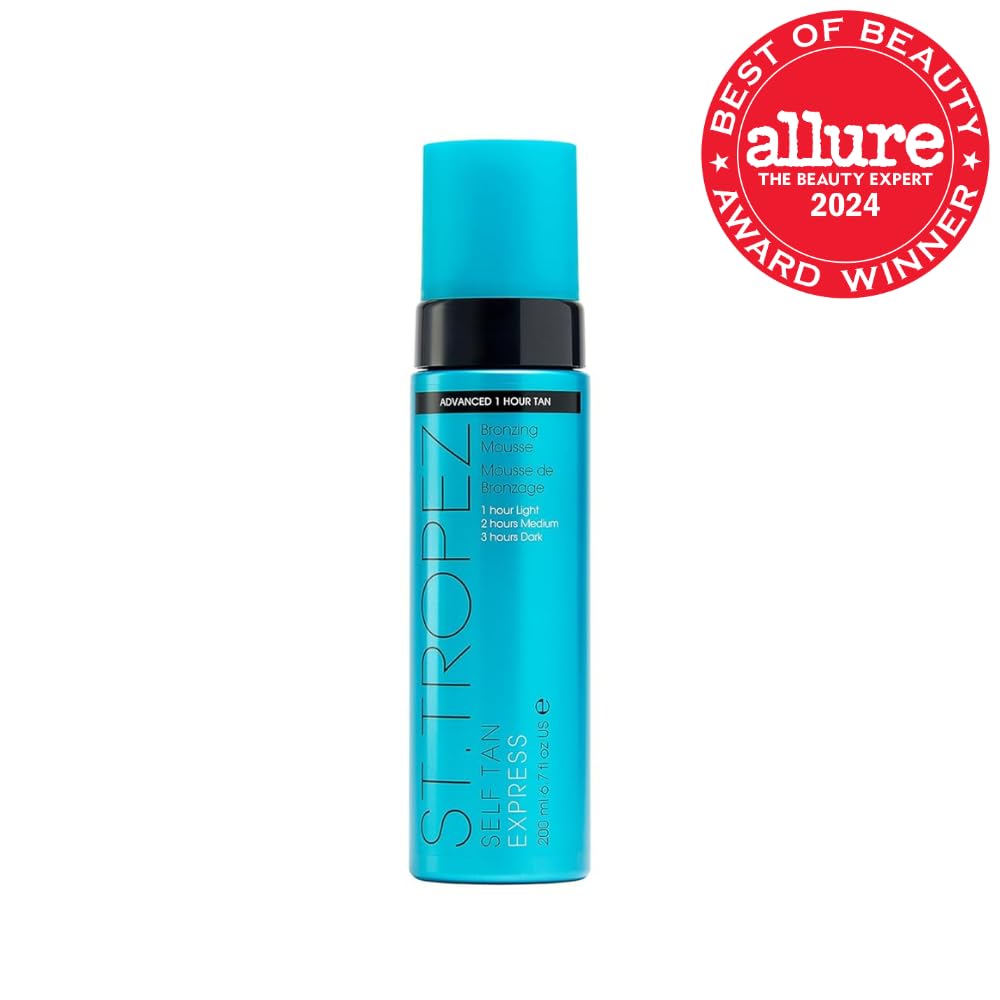
St. Tropez Express Bronzing Mousse
St. Tropez’s express line is the category reference point, and Allure’s best self-tanners coverage consistently places it among top performers for finish quality. The reason enthusiasts return to it is undertone control: reviewers across Allure and Byrdie consistently describe the result as leaning warm-neutral to golden rather than orange, particularly on medium Fitzpatrick types (III–IV). The mousse texture applies with a mitt in a way that most intermediates find intuitive — it dries quickly enough not to transfer, and the cosmetic bronzer in the formula (a wash-off guide color) shows immediately so you can check your application before the real color sets.
The tradeoff: at roughly $35–$42 for 200ml, the cost-per-application math runs higher than b.tan, and reviewers on deeper skin tones (Fitzpatrick V–VI) note that the lighter express windows (1 hour) can read sheerer than expected, requiring a longer wear time or layering strategy to build meaningful depth.
Loving Tan 2 Hr Express Mousse
Loving Tan occupies an interesting middle position: it prices competitively (around $35–$38 for 200ml) but the formula is built around a fixed 2-hour window rather than a sliding scale. That rigidity is actually a feature for tanner anxiety — there’s less mental overhead around when to rinse because the formula is calibrated for one target result rather than a spectrum.
Harper’s Bazaar’s express self-tanner coverage notes that Loving Tan’s 2-hour express is a consistent reviewer favorite for olive-leaning finishes — the result tends to read slightly cooler and deeper than St. Tropez’s express line, which makes it particularly well-suited to Fitzpatrick IV–V skin tones seeking a rich result without warmth that reads orange. The caveat: reviewers on fairer skin (Fitzpatrick I–II) occasionally report that even the 2-hour window produces more depth than anticipated, suggesting starting with the brand’s “medium” version before moving to “ultra dark.”
b.tan Express Mousse
b.tan operates as the value-forward outlier in this comparison — pricing around $15–$19 for 200ml — but the brand has built genuine enthusiast credibility with its flexible develop window and notably high DHA concentration. Byrdie’s self-tanner coverage has highlighted b.tan’s express line for delivering professional-adjacent depth at a fraction of the premium brand price.
Where b.tan differs mechanically: the formula is designed to work at 1 hour for light color but genuinely scales deeper with longer wear, functioning almost as a classic overnight formula if you leave it 6–8 hours. For deeper skin tones or tanners trying to build significant color in fewer applications, that flexibility has real value. The honest tradeoff is fragrance — b.tan’s signature scent is polarizing, and reviewers who cite the “biscuit smell” concern (a well-documented DHA oxidation note) are not wrong to flag it. The brand leans into fragrance masking rather than formulation-level odor elimination, which makes it a different experience than Loving Tan or St. Tropez’s more neutral finishes.
Making the Decision: An “If X, Then Y” Framework
At the intermediate-to-enthusiast level, develop-time choice is really a proxy for four variables: your available shower window, your target depth, your Fitzpatrick type, and your tolerance for re-application. Here’s how to map those:
If you have an unpredictable schedule and need flexibility: St. Tropez Express’s sliding 1–3 hour window is the safest architecture. You can cut the session short for a lighter result or extend it if life interrupts, and the formula is forgiving enough that an extra 20–30 minutes rarely produces a drastic overcorrection.
If you want deep color and olive undertones in one application: Loving Tan 2 Hr Express on a Fitzpatrick III–V skin delivers consistently rich, non-orange results per aggregated reviewer consensus. Commit to the two-hour window and you get a predictable, repeatable outcome.
If you’re building a layering routine on deeper skin or want maximum depth per session: b.tan’s flexible window makes it a strong case, and the cost-per-application math (roughly $0.20–0.30 per session at typical mitt usage) means you can layer more aggressively without watching the budget. Pair it with an odor-conscious post-tan moisturizer if the fragrance profile is a concern.
If you’re new to express formulas and fair-skinned: Any express formula deserves a conservative first trial — rinse at the lower end of the window, assess at hour 24, and extend the next session if you want more depth. Classic overnight formulas are lower-stakes for first-time build because the slower reaction rate gives you a gentler learning curve.
If you’re layering over a base tan: The develop-time math compounds. A 2-hour express session on skin that already has a base from a previous application will read noticeably deeper than the same session on bare skin. This isn’t a warning so much as a technique — it’s how editorial and professional-adjacent tanners build the layered depth that reads three-dimensional rather than flat.
One thing no develop-time guide can promise: final color on your specific skin. Healthline and Paula’s Choice both note that DHA response varies with individual skin chemistry, amino acid density, and hydration level. A hydrated, exfoliated skin surface will develop more evenly and predictably than dry or recently exfoliated skin. That variable lives outside the formula and entirely inside your prep routine — which is where the real gains come from once you’ve chosen your bottle.